

CHARACTERS OF ARTHURIAN LEGEND
Merlin the Magician
Who was Merlin?
King Arthur’s most trusted advisor, prophet, magician, and friend, Merlin was almost certainly the creation of Geoffrey of Monmouth, who writes extensively about Merlin in his twelfth century work The History of the Kings of Britain. Geoffrey combined tales and stories of a bard and wizard named Myrddin, who was created by a ninth century mystic named Nennius. Nennius chronicled that Myrddin had been born of no earthly father and used his wizardry and powers to foretell the defeat of the British by the Saxons.
King Arthur’s most trusted advisor, prophet, magician, and friend, Merlin was almost certainly the creation of Geoffrey of Monmouth, who writes extensively about Merlin in his twelfth century work The History of the Kings of Britain.
Geoffrey changed the name of the character from Merdinus to Merlinus, with the former too close to the Anglo-Saxon word merde – slang for excrement. In The History of the Kings of Britain, Merlin assists Uther Pendragon (Arthur’s father) and is responsible for transporting the stones of Stonehenge from Ireland, but he is not directly associated with Arthur. In addition to the History of the Kings of Britain, Geoffrey of Monmouth also authored a work specifically on Merlin entitled “The Prophecies of Merlin”, which later became the seventh book in the History of the Kings of Britain. These led to a tradition that is manifested in other medieval works, in eighteenth-century almanac writers who made predictions under such names as Merlinus Anglicus, and in the presentaion of Merlin in later literature.
During the Middle Ages, Merlin became very popular. Not only does he figure prominently in the French Vulgate Cycle, but he shines in the French and English romances. Sir Thomas Mallory is the first to really showcase him as the advisor and guide to King Arthur in his work Le Morte d’Arthur. And ever since the Renaissance, Merlin the magician has remained popular in all Arthurian legends and tales. In The Idylls of the King, Alfred Lord Tennyson makes him the architect of Camelot, and Mark Twain uses him in his works as a villain. Numerous novels, poems and plays center around Merlin, and in American literature and popular culture, Merlin is perhaps the most frequently portrayed Arthurian character.
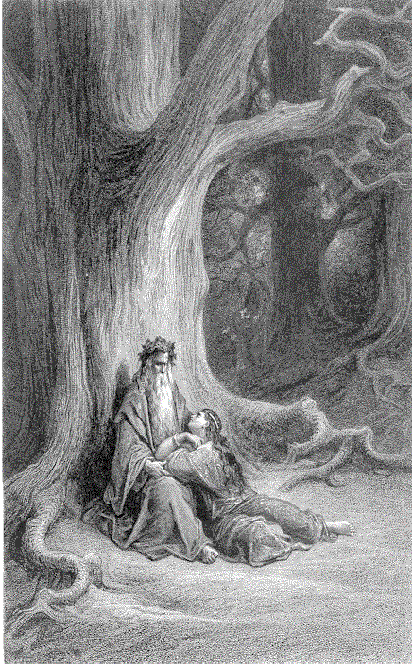
Merlin falls victim to the spells of his own apprentice, Vivien, who may have been the Lady of the Lake.