

Was King Arthur truly a Historical figure or simply a legendary icon?
At the heart of all Arthurian Legends is the King himself. Was King Arthur a real, historical figure or simply a creation of poets and writers over hundreds of years of legends? King Arthur was said to be the son of Uther Pendragon and Igraine of Cornwall. Arthur is a near mythic figure in Celtic stories such as Culhwch and Olwen, and in early Latin chronicles he is presented as a military leader, the Dux Bellorum. In later romance he is presented as both King and Emperor.
Ever since the Renaissance, the question has been debated with veracity. During the reign of the Tudors and their monarchy, King Arthur’s existence was defended strongly, because the Tudors traced their lineage all the way back to King Arthur.
The age old question regarding King Arthur is: was he real? And if so: who was he, really? Ever since the Renaissance, the question has been debated with veracity. During the reign of the Tudors and their monarchy, King Arthur’s existence was defended strongly, because the Tudors traced their lineage all the way back to King Arthur. Modern takes on King Arthur generally agree that there was a true, historical character at the heart of the Arthur that we have come to know, but not necessarily one suited in shining armor and surrounded by knights of the round table. In “The Nature of Arthur“, O.J. Padel argues “historical attributes of just the kind that we find attached to Arthur can be associated with a figure who was not historical to start with.”
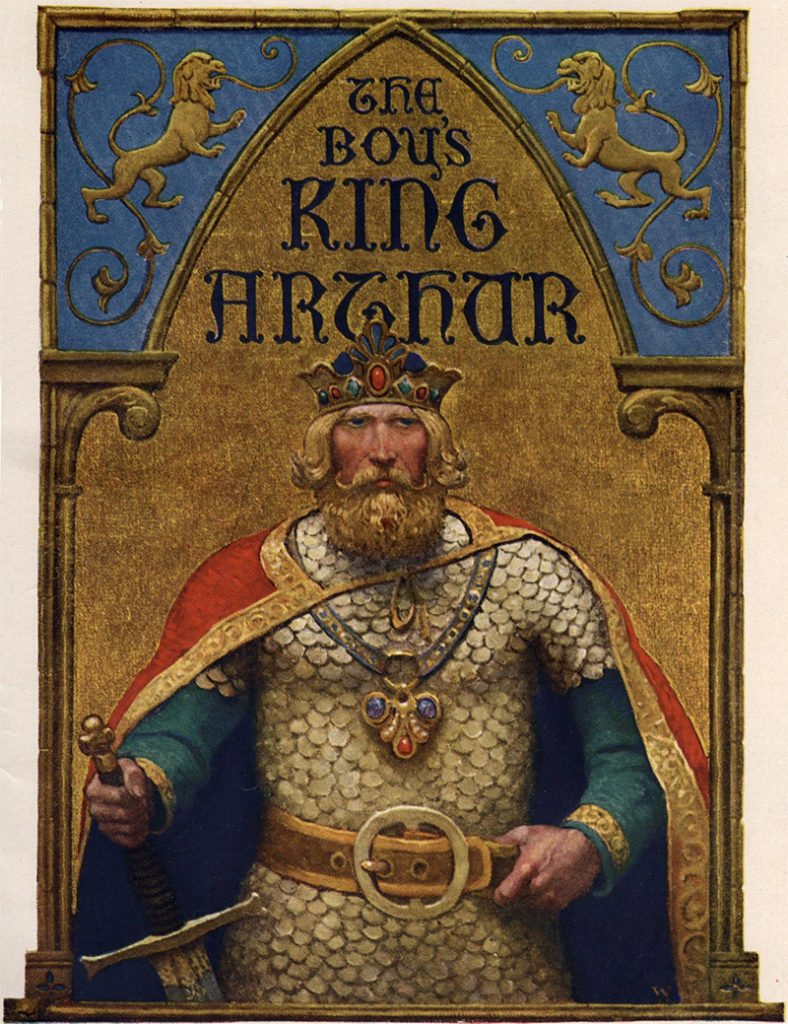
N. C. Wyeth’s title page illustration for The Boy’s King Arthur (1922)
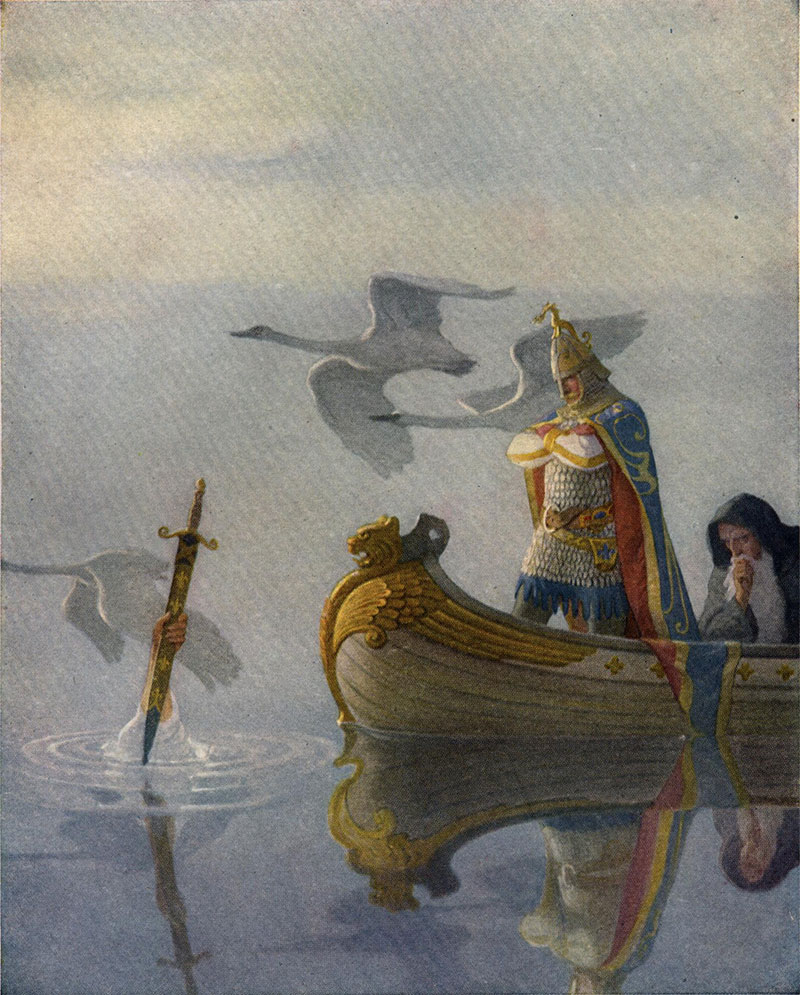
Arthur receiving the later tradition’s sword Excalibur in N. C. Wyeth’s illustration for The Boy’s King Arthur (1922), a modern edition of Thomas Malory’s 1485 Le Morte d’Arthur
A Historical Basis for King Arthur
A true historical basis for King Arthur is to be made. And he most certainly gained fame as a warrior battling the Germanic invaders of the late fifth and early sixth centuries. Yet since there is no way to 100% guarantee the existence of a character named: Arthur, the debate will continue on. From the Middle Ages to the present, the influence of Arthur upon literature, culture, music and art cannot be denied. Though countless works have been written or created based upon Arthur, the King Arthur of the Middle Ages is the one who has most captured the imaginations of audiences, both young and old.
The King Arthur of Thomas Malory’s Le Morte D’Arthur and TH White’s The Once and Future King is the Arthur that has been established as almost other-worldly hero and the first knight of an order of knights so great they would be etched into history.
The King Arthur of Thomas Malory’s Le Morte D’Arthur and TH White’s The Once and Future King is the Arthur that has been established as almost other-worldly hero and the first knight of an order of knights so great they would be etched into history. Central to the myth is the downfall of Arthur’s kingdom. It is undermined in the chronicle tradition by the treachery of Mordred. In the romance tradition that treachery is made possible because of the love of Lancelot and Guinevere.